There's a quiet assumption most people carry into their 40s, 50s, and 60s: that a step gets slower, a reaction gets a beat behind, a swing loses some snap, simply because that's what happens with time.
There's a quiet assumption most people carry into their 40s, 50s, and 60s: that a step gets slower, a reaction gets a beat behind, a swing loses some snap, simply because that's what happens with time. The research on skeletal muscle tells a different story. The power people associate with aging isn't disappearing because of age. It's disappearing because it stopped being asked for — and what isn't asked for, the body quietly stops maintaining.
Skeletal muscle is made of two broad fiber types, and they are not interchangeable. Slow-twitch fibers are built for endurance — they fire at low force for long durations, and they are exactly what gets recruited during walking, standing, and most of the low-intensity movement that fills an ordinary day.
Fast-twitch fibers are built for something else entirely: rapid, high-force output. They're what fire when you catch yourself on a curb, drive a golf ball, sprint for a bus, or push up out of a low chair without using your hands. Ordinary daily movement barely touches them. If a muscle fiber type is never asked to work near its capacity, the nervous system has no reason to keep it fully staffed — so it doesn't.
The common wisdom for training as we get older leans toward caution: lighter weights, higher reps, gentler intensity. It's well-meaning advice, and it's aimed at the wrong target. Moderate-load training keeps slow-twitch fibers engaged, but it rarely generates enough force to reach the threshold where fast-twitch fibers get called into action.
The consequence isn't just a smaller muscle. It's a slower, less reliable response system — the exact system responsible for the split-second correction that turns a stumble into a recovered step instead of a fall.
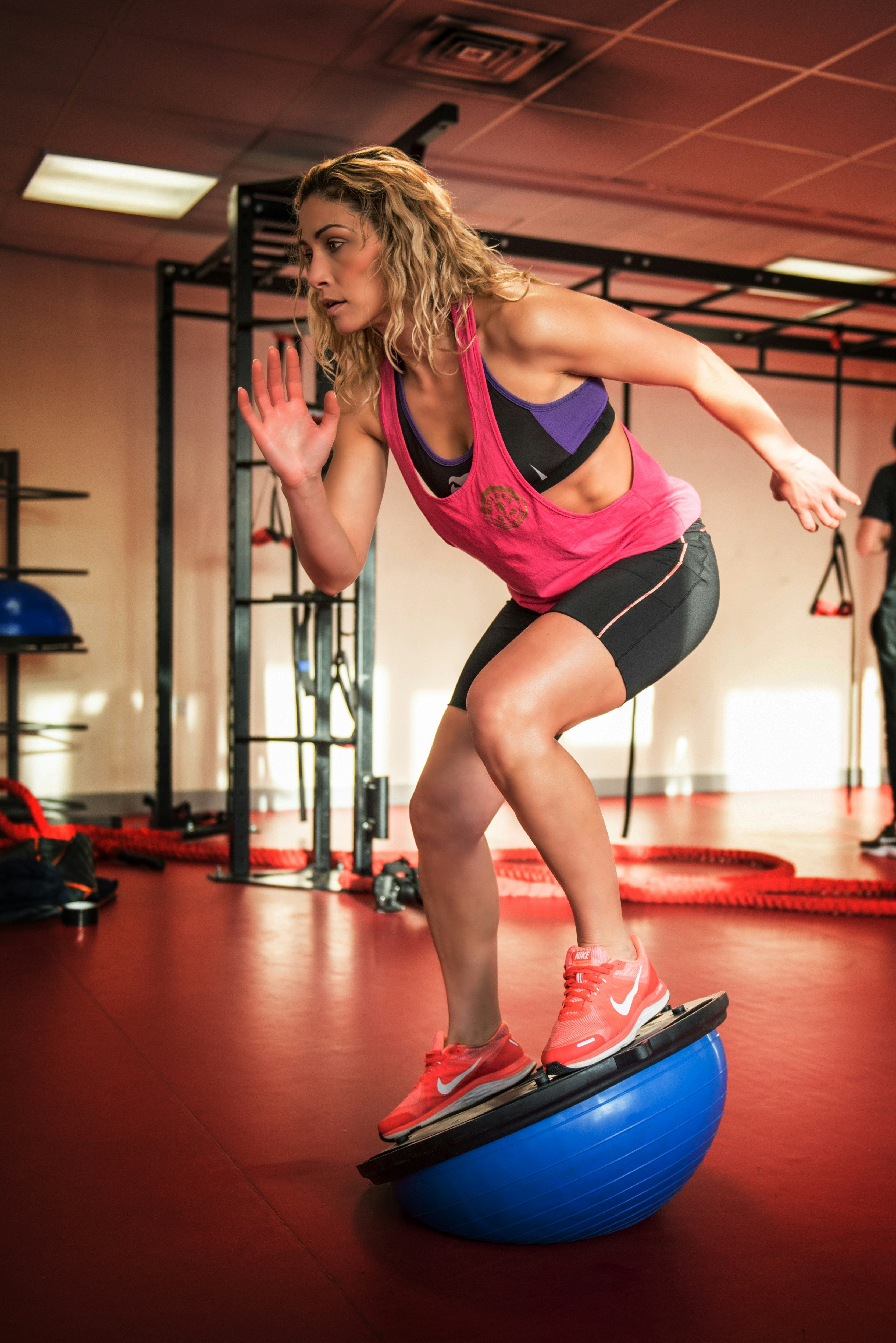
These three qualities get talked about separately, but physiologically they come from the same source. Balance under a sudden shift in weight, the reactive strength to catch yourself off guard, the power to move explosively when it counts — all of it depends on fast-twitch fibers that are still online and a nervous system still practiced at recruiting them quickly.
This is why training programs that only build slow, steady strength can leave someone feeling strong in the gym but no more stable on uneven ground. The fibers responsible for stability under real-world, unpredictable load were never part of the stimulus.
AiPerformance's eccentric protocol is built specifically to reach fast-twitch fibers, using the controlled lengthening phase of a movement — the lowering, the braking, the deceleration — to generate a demanding stimulus without needing extreme loads or high-impact movement. It is deliberate, controlled, and precisely dosed, which is what makes it appropriate at any age and any starting point. The eccentric phase of training forces the nervous system to engage both the fast twitch and slow twitch fibers. This allows you to find them more readily when you need them.
Over consistent sessions, clients don't just get measurably stronger. They report something harder to quantify but easy to feel: more confidence on stairs, steadier footing on a hike, a swing or a serve with more snap behind it. That's the fast-twitch system coming back online and your body finding them quicker and easier.
“The power to catch yourself, react quickly, and move with confidence isn't lost to time. It's lost to disuse — and disuse can be reversed.”
None of this requires becoming an athlete or training like one. It requires giving the muscle fibers responsible for power and balance a reason to stay strong and engaged. That reason doesn't expire with age. It only expires with disuse.
Contact us
info@aiperformance.com • (970) 222-3002
1297 Main St #1, Windsor, CO 80550