If you’ve ever dealt with nagging knee soreness, shoulder impingement, or Achilles tightness, you’ve probably been told that joint pain is just an unavoidable part of aging or heavy training. But in most cases, joint pain isn't actually a "joint" problem—it’s a tissue capacity problem.
While muscles adapt quickly to workout stress, your tendons, ligaments, and fascia adapt at a much slower rate. When training stress exceeds the load capacity of these connective tissues, inflammation, stiffness, and chronic pain follow.
Building durable, "bulletproof" joints requires targeted strategies designed specifically to increase connective tissue load capacity without overloading the joints themselves.
Here is the science behind tendon and ligament adaptation, why standard strength routines often fall short, and how specialized eccentric loading builds long-term joint resiliency.
To understand joint durability, you need to look at the structural differences between muscle tissue and connective tissue (tendons and ligaments).
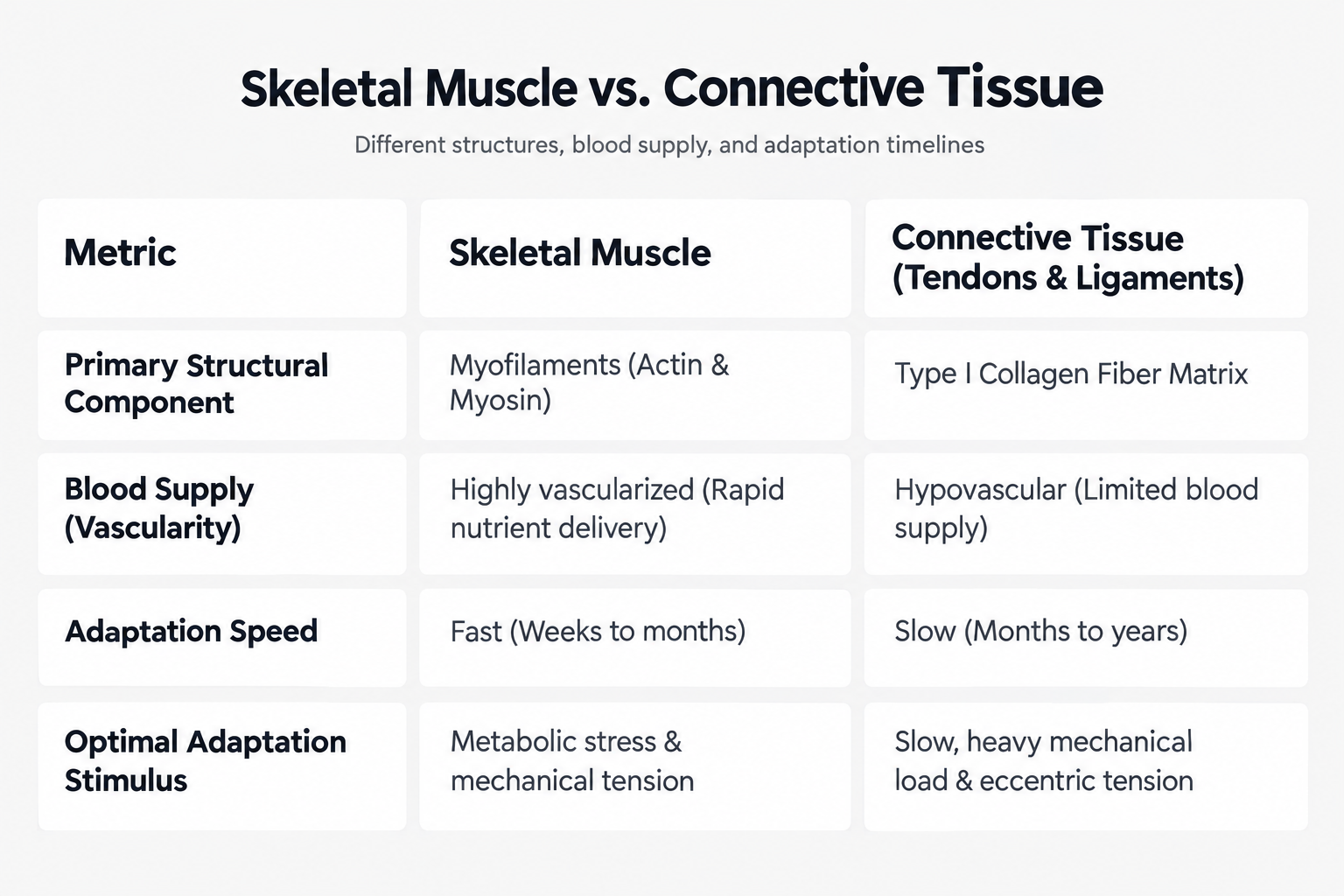
Because muscle tissue has a robust blood supply, it repairs and grows quickly in response to exercise. Tendons and ligaments, by contrast, receive far less blood flow. When you rapidly increase workout volume or intensity, your muscles may adapt easily, but your connective tissue trails behind.
Over time, this disparity creates a structural imbalance: a powerful engine attached to weak cables. The result is micro-tears, tendinopathy, and joint irritation.
You cannot build stronger tendons and ligaments with fast, explosive reps or light, high-rep cardio. Connective tissue requires specific mechanical stimuli to remodel collagen fibers and increase tensile strength.
Collagen synthesis in tendons is triggered by heavy mechanical strain. High loads signal cells called tenocytes to align and reinforce collagen fibers along lines of stress, making the tendon stiffer and more resilient against tensile forces.
The eccentric phase—lowering a weight slowly under tension—allows you to apply higher loads to connective tissue with significantly lower cardiovascular strain and reduced compression inside the joint capsule. Research shows slow eccentric loading is the gold-standard protocol for rehabilitation and tendon remodeling.
Fast, momentum-driven movements transfer force away from tendons. Slow, deliberate movement tempo (3 to 5 seconds during the lowering phase) keeps continuous strain on connective structures, encouraging cellular remodeling and fluid movement within the extracellular matrix.
Standard weightlifting can be a double-edged sword for joint health. Loading heavy enough to stimulate tendon growth often puts excessive compression and shear force on sensitive joint surfaces.
At AiPerformance, our specialized strength protocols solve this dilemma:
Whether you are recovering from tendinopathy, trying to stay pain-free, or preparing your body for high-level athletic performance, strengthening your connective tissue capacity is the ultimate insurance policy.
Stop waiting for joint discomfort to dictate your active lifestyle. By giving your tendons and ligaments the precise mechanical stimulus they need, you can build structural integrity that lasts a lifetime.
Ready to bulletproof your body from the inside out?
👉 Start building bulletproof joints