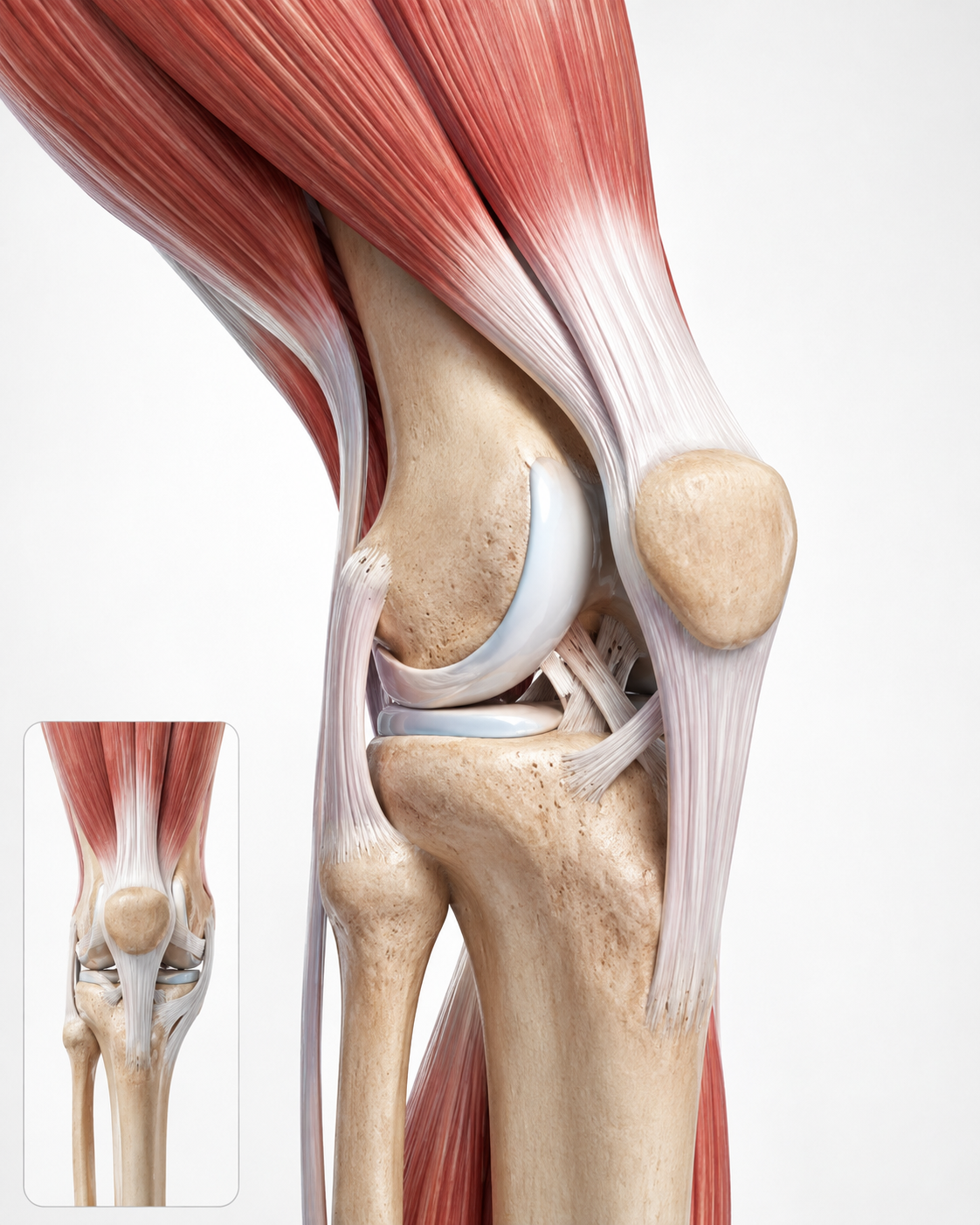
Daily life keeps muscles reasonably strong. It rarely gives connective tissue the graded, progressive exposure it needs to keep pace — so the first demanding weekend of the season becomes the first real test the structure has faced in months.
Most connective tissue injuries don't happen during a heavy lift or a hard training session. They happen on an ordinary Saturday — a hike, a pickup game, a weekend of yard work — doing something well within a person's apparent strength. The muscle was ready. Something else wasn't. That gap between how strong a muscle can be and how much force it and the surrounding structures can actually absorb is where most of these injuries quietly originate.
Any engineered structure is only as strong as its most limited component, no matter how strong the rest of it is. The same logic governs the body. A muscle trained hard enough can generate more force than the tendon transmitting that force was ever conditioned to handle safely.
This creates a hidden ceiling that doesn't show up on a strength test. You can feel powerful, move confidently, and still be carrying a mismatch between what your muscles can produce and what your tendons and ligaments can absorb — a mismatch that stays invisible right up until a single sharp movement exposes it.
Tendons and ligaments get some attention in injury prevention conversations. Cartilage almost never does, despite being just as dependent on the right kind of mechanical signal. The cells responsible for maintaining healthy cartilage respond to graded compressive and shear loading by keeping the joint surface well-nourished and structurally sound — cartilage has no direct blood supply, so movement and controlled loading are how it gets fed.
Without adequate, well-distributed load, cartilage can thin over time. But erratic, high-impact load — the kind that shows up in unplanned recreational activity rather than structured training — can degrade it just as easily in the other direction. Controlled, progressive loading is the narrow lane that keeps joint tissue healthy without overloading it.
Chronological age gets blamed for a lot of injuries that are really about something called training age: how many years a person's connective tissue has actually spent adapting to progressive, structured load. A 55-year-old with three consistent years of controlled eccentric training often has more resilient tendons, ligaments, and joint surfaces than an untrained 30-year-old who only moves hard sporadically.
This is why the 'weekend warrior' pattern is so often the setup for injury. Daily life keeps muscles reasonably strong. It rarely gives connective tissue the graded, progressive exposure it needs to keep pace — so the first demanding weekend of the season becomes the first real test the structure has faced in months.
“Your muscles will happily generate more force than your tendons are ready to catch. The gap between the two is where most injuries live.”
AiPerformance's eccentric-focused protocol is built to close that gap deliberately, in a controlled setting, months and years before a hike, a swing, or a Saturday pickup game asks your connective tissue for something it was never prepared to give.
Contact us
info@aiperformance.com • (970) 222-3002
1297 Main St #1, Windsor, CO 80550